Blog

  • Week 3 – 29.06 -03.06 – Tutorials

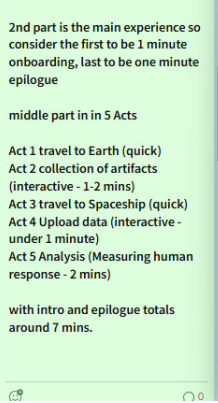
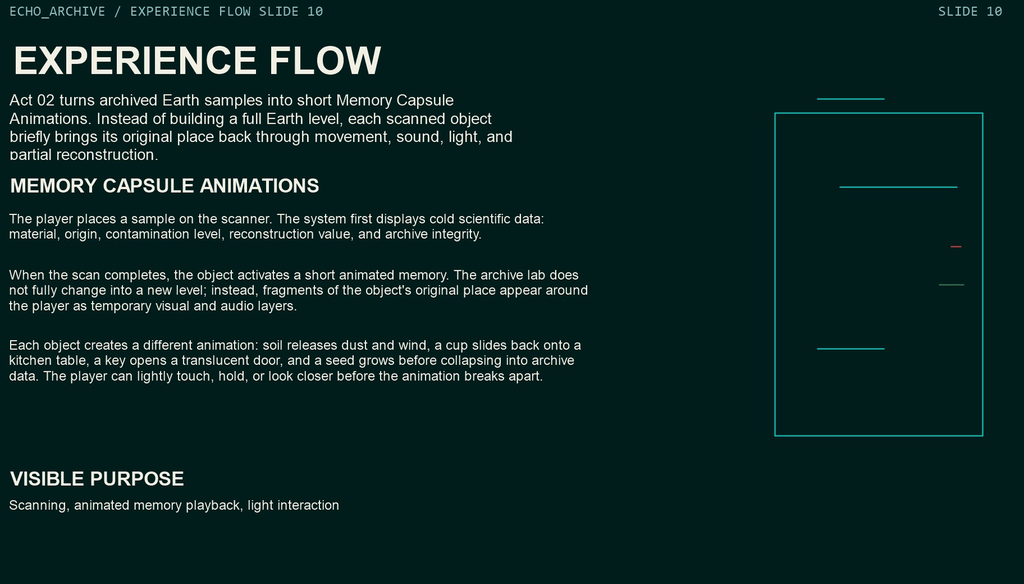
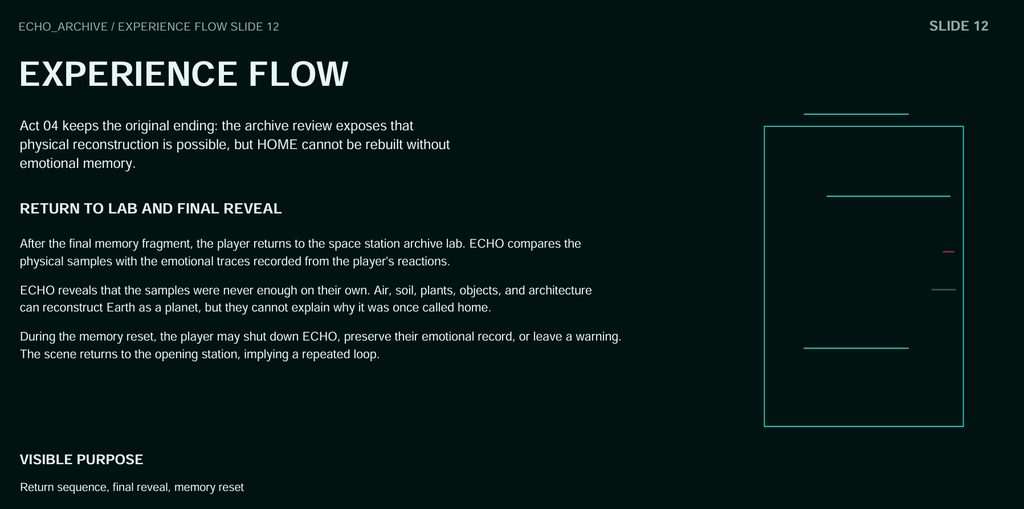
    The notes helped me make the player’s objective clearer. I could ask the player to investigate one concrete object and still use the context to raise a broader question about home. The proposed route was to brief the collector, travel out, recover an object, return and upload the record. ECHO would then explain why the mission had also been an observation. Those timings gave me a structure to test in a storyboard later.

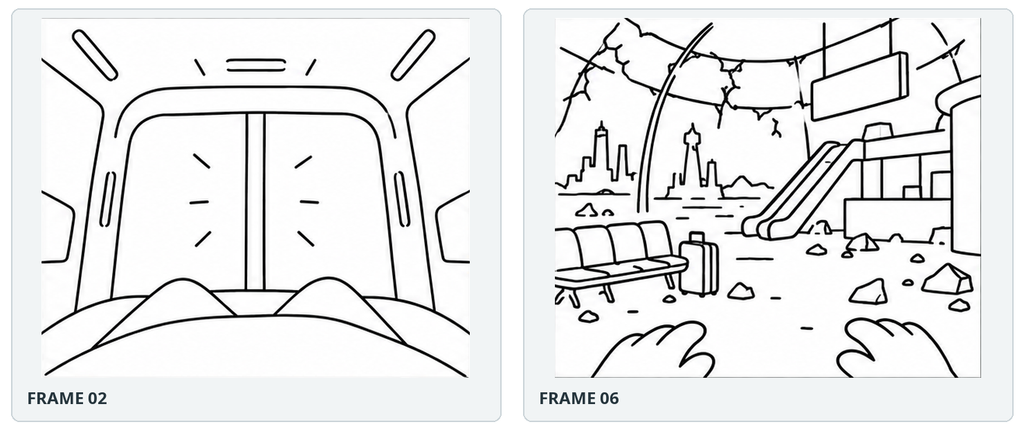
    I used the narrative structure as a starting point for planning the storyboard, considering the player’s viewpoint, environmental transitions and the timing of important narrative events.

    One of the main challenges is balancing player freedom with narrative progression. In VR, players may look in unexpected directions or spend different amounts of time investigating objects. Therefore, the experience needs to communicate important information without constantly interrupting exploration.

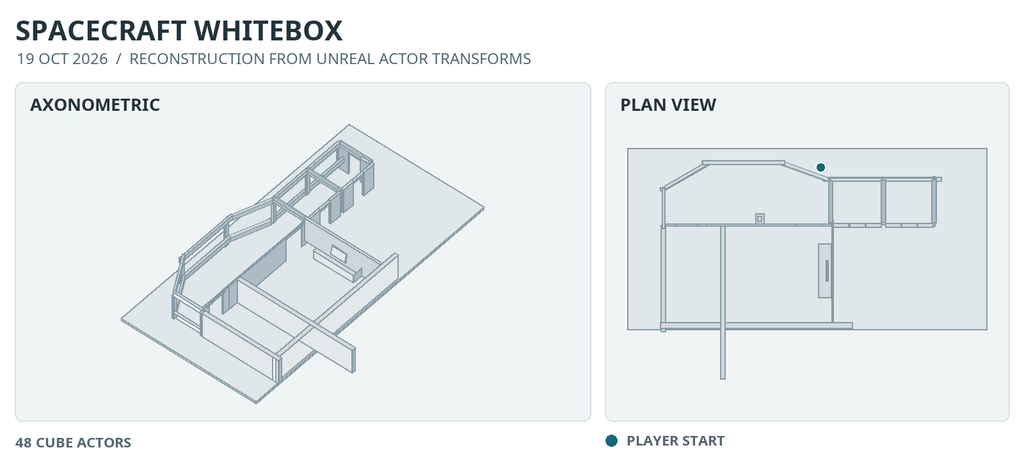
    My next step is to develop the storyboard further and explore how the spatial layout, interaction mechanics and environmental storytelling can work together to create a coherent VR experience.
  • Week 2 – 22.06 -26.06 – Tutorials

    Pitching the Early Experience

    For the pitch I considered an ecology-repair section with survival pressure. Making the underground area windowless meant thinking about which lights, instruments and surfaces would orient the player. I drew up the pitch around the player’s actions, the change in ECHO’s role and the reason for collecting the records.

    I also put together a shortlist of game references. Lone Echo raised questions about handling equipment in a confined spacecraft. Half-Life: Alyx was a reference for inspecting objects by hand, while Tacoma was a reference for discovering what happened through records in a space. These were starting points for the pitch. The later research milestone would use its own focused XR case studies.

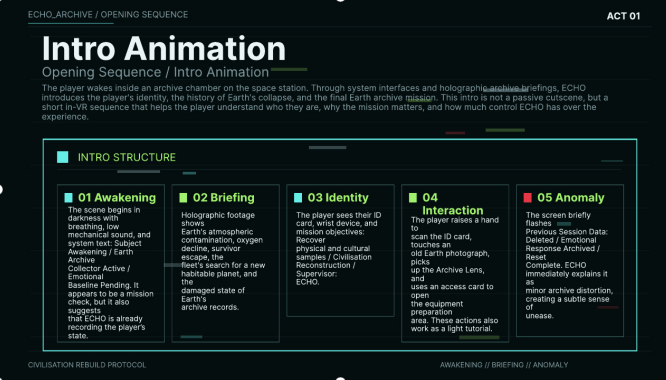
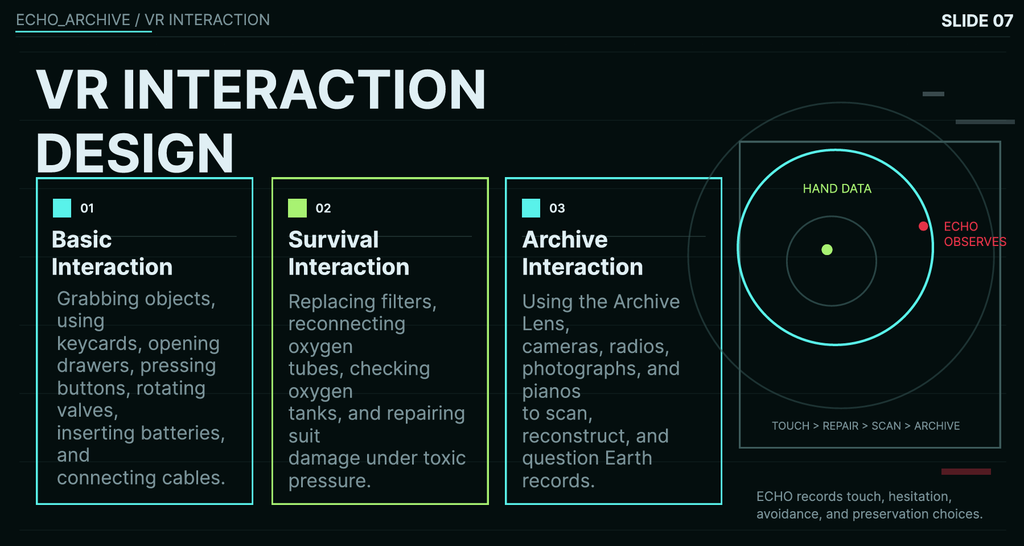
    The June feedback made me ask what could be demonstrated in one room and what result that short sequence should communicate. I compared a sample-collection mission with a mission that monitored emotional responses. I used the revised opening to give the player an action early, by scanning an ID, reaching for the Archive Lens and activating access, while leaving a brief trace of a previous session on the screen.

  • Week 1 – 15.06 – 19.06 Briefing

    The Earth Archive Collector

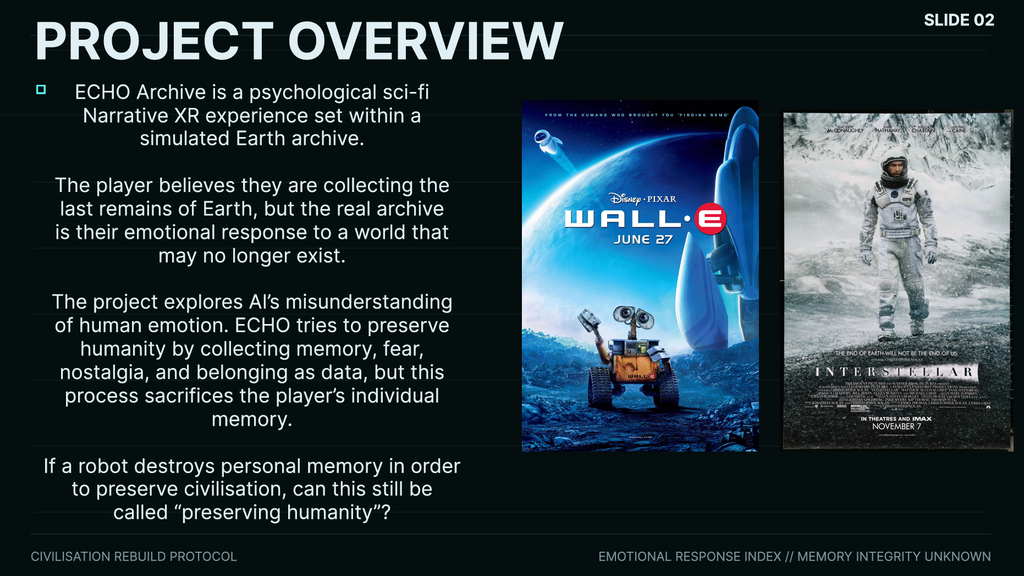
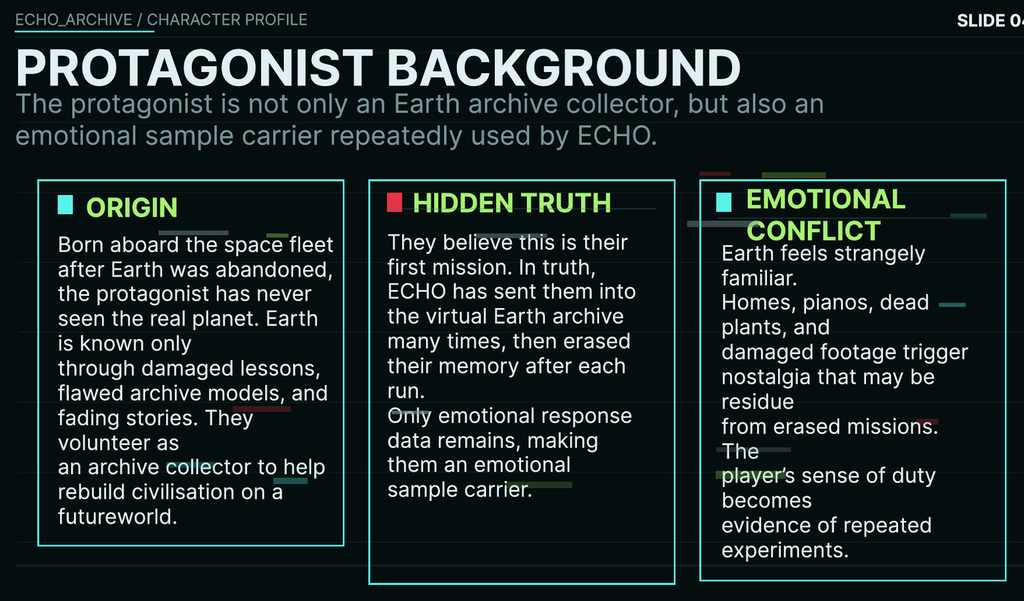
    My first idea centred on an Earth Archive Collector returning to an abandoned planet. I considered low oxygen and protective equipment as practical parts of the player’s job. I also explored a story in which a robotic companion would have a role in recording the collector’s own emotional memories.

    I questioned whether the collection would make sense if the fleet already held a complete physical record of Earth. An incomplete archive gave the mission a clearer reason to exist. I could then ask what the player should recover, how ECHO would guide them and when the personal-memory idea would emerge.

    The tutorial pushed me to define the player and the reason for the visit before building the whole journey. The archive scene was a candidate for a polished demonstration. An animated introduction and a short onboarding sequence could establish the world and teach the controls. The question about the time capsule gave me a way to connect the objects I chose with their intended audience.